
A sluggish campaign
Observations from the first phase of the LDP leadership race

Thank you for reading Observing Japan. This post is available to all readers.
If you are looking for timely, forward-looking analysis of the stories in Japans’s politics and policymaking that move markets, I have launched a service through my business, Japan Foresight LLC. For more information about Japan Foresight’s services or for information on how to sign up for a trial or schedule a briefing, please visit our website or reach out to me.
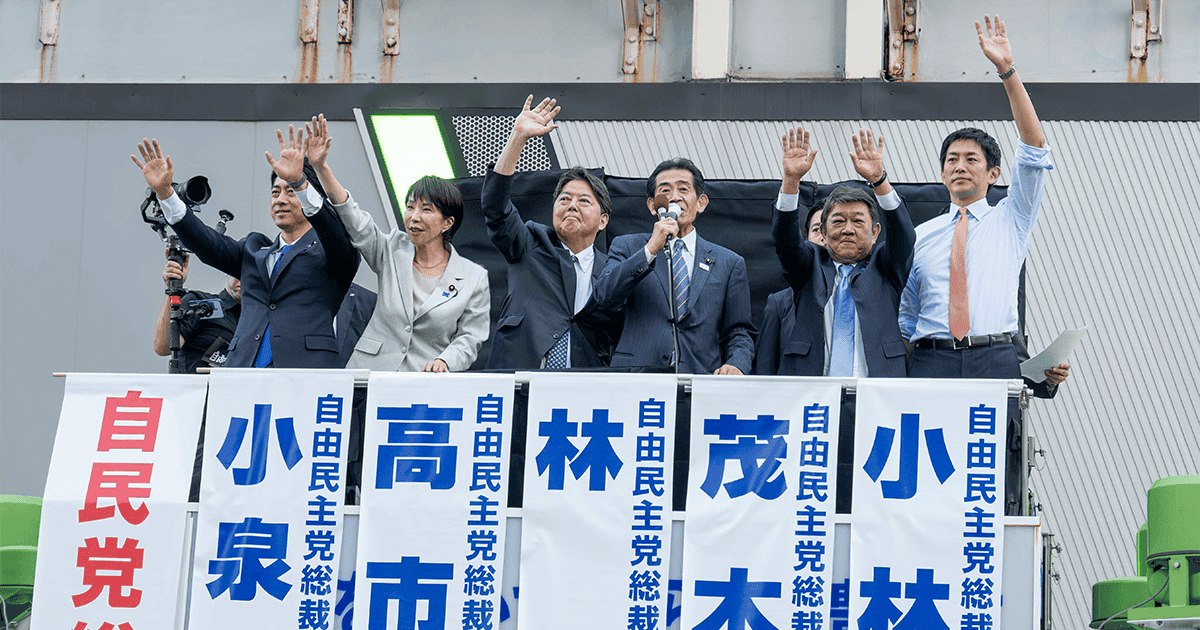
The first phase of the campaign – featuring the heaviest concentration of party-sponsored public events and debates – is over, and it is possible to make some preliminary notes on what we have learned thus far.

What we’ve learned about the leadership race
First, as far as substance is concerned, the contest is Takaichi versus the rest. Takaichi Sanae appears to be the only candidate willing to assert bold positions that separate her from the pack. On fiscal policy, she is open to using deficit bonds to finance stimulus spending. She is skeptical about a consumption tax cut in the near term as part of a supplemental budget but is open to discussing it over the medium term. She has questioned the Bank of Japan’s (BOJ) announcement last week about selling off ETF and REIT holdings. She has also – in contrast to the others – called for a more aggressive timeline for coalition negotiations, suggesting that they should be completed before the new government is confirmed by the Diet. She has also, as seen in her remarks at the opening forum, taken a more aggressive position on Japan’s foreign population and over-tourism.1 The other four candidates have taken much more cautious stances across the board. That said, even Takaichi may not be so great an outlier. All of the candidates want to show the public that the government is moving quickly to address their concerns; most have emphasized the need to build a strong team from across the party; everyone wants to try to bring a new coalition partner into the government; no one is in a hurry to call a snap election. There is enthusiasm about moving quickly to pass a supplemental budget that includes some proposals from opposition parties but no one thinks that that consumption tax can or should be reduced in the immediate term. They all agree that Japan faces a severe international environment and support raising defense support, though no one wants to specify how much higher defense spending should go or how it should be financed.
The fact is that each candidate has stuck strictly to their political brands. The start of the campaign has, if nothing else, featured impressive displays of message discipline. Takaichi is running as the conservative stalwart; Kobayashi is playing up the importance of youth while advocating an Abe-like program; Koizumi is cautiously emphasizing the need to address the cost-of-living crisis above all else2; Motegi and Hayashi are in their own ways playing up their experience and leadership abilities. It makes for relatively frictionless debates – and, as journalist Izumi Hiroshi argues, a sluggish campaign.3 No candidate is working too hard to rattle the others.
Finally, none of the candidates has communicated a particularly sophisticated plan for how they intend to approach the Trump administration. When asked how they would work with US President Donald Trump – who, by the way, wants to visit Japan around the time of the 31 October-1 November APEC summit in South Korea – the candidates have talked about the need to build a relationship founded on trust with the US president, but none has gone beyond vague generalities when it comes to how they would accomplish this feat. Indeed, in the 24 September debate at the National Press Club, Motegi asked Koizumi for a specific strategy for managing Trump, and Koizumi said…he would meet Trump as soon as possible and establish a relationship of trust. Motegi, meanwhile, has said in multiple events that he wants to pursue further reductions in US tariffs, an ambition that seems unrealistic.
A Takaichi shift?


Nippon TV has released a new poll of LDP supporters on Thursday, 25 September that showed a significant move in party supporter. Since the previous NTV poll – conducted 19-20 September – Takaichi Sanae gained six points to climb to 34%, surpassing Koizumi Shinjirō, who fell four points to 28%. Meanwhile, Hayashi Yoshimasa gained two points to 17%, ever so slightly closing the gap with Koizumi and Takaichi. Using a d’Hondt method calculator and assuming similar turnout to last year’s 66%, this could translate into a vote split of 115 for Takaichi, 94 for Koizumi, 57 for Hayashi, 16 for Kobayashi, and 13 for Motegi.
One poll does not necessarily spell disaster for Koizumi, but after watching Koizumi’s support fade last year – denying him a place in the runoff – a ten-point swing after the first several campaign events cannot be waved off either. Koizumi may also be dealing with some negative press after Shukan Bunshun reported that Makishima Karen, an LDP lawmaker handling public relations for Koizumi’s campaign, emailed his supporters to encourage them to make supportive comments during a Koizumi appearance on a Nico Nico streaming program.
His support among lawmakers could be strong enough to make up for weaker public support, though if his public support fades, it could lead undecided lawmakers – still 107 of 295 according to Ooha Mazaki’s indispensable tracker – to break for other candidates. The bottom line is that Koizumi, while still in the strongest position on the basis of his relative strength among both rank-and-file supporters and lawmakers, is not in an impregnable position.
Shadow coalition talks
On Wednesday, 24 September, former prime minister Suga Yoshihide, a key supporter for Koizumi, met with Endō Takashi, Ishin no Kai’s parliamentary affairs chief. These kinds of meetings are a) to be expected and b) indispensable if the LDP is indeed serious about bringing a new coalition partner into the government. As noted above, this is an issue that has been discussed in the candidate debates, because there is a tricky issue with the timing. While the timing for an extraordinary session of the Diet that will select the new prime minister has not been set – presumably sometime in mid-October – the government will presumably want to have settled coalition talks before the Diet votes on a leader, determining the distribution of cabinet posts and agreeing on policy priorities, not to mention at least laying the groundwork for possible electoral coordination. This process is further complicated by Kōmeitō’s involvement. While it may be desirable for the LDP to conclude these talks before the government takes office, as Takaichi has argued, it is difficult to see how those talks could be concluded if they do not start until after the 4 October election. Thus, we should expect to see communication between the surrogates of the LDP’s candidates and opposition parties in the coming weeks.
Ishin no Kai, for its part, has been working on draft legislation for its “auxiliary capital” proposal, which is likely to play an important part in any coalition talks.
Further reading
The history of the LDP’s most dramatic leadership elections.
Conservative Party of Japan lawmaker Takegami Yūko is leaving the party, protesting the leadership of Hyakuta Naoki and Kawamura Takashi.
Takaichi spoke with the Sankei Shimbun about her candidacy. She also spoke with the Asahi Shimbun.
Hayashi was interviewed by Diamond, largely about economic policy.
Democratic Party for the People (DPFP) leader Tamaki Yūichirō offered his thoughts on the LDP candidates.
He may also be too careful, consulting his notes constantly. Constitutional Democratic Party leader Noda Yoshihiko offered some unsolicited advice to Koizumi to not look at his notes so much.
ugh i am now out on koizumi i thought he was gunna be charismatic but he's just playing scared