
System in crisis
Combing through the results of a historic upper house election

Thank you for reading Observing Japan. This post is available to all readers.
If you are looking for timely, forward-looking analysis of the stories in Japans’s politics and policymaking that move markets, I have launched a new service through my business, Japan Foresight LLC. For more information about Japan Foresight’s services or for information on how to sign up for a trial or schedule a briefing, please visit our website or reach out to me.
I was quoted in an article in the New York Times on the election outcome, “Japan’s Long-Dominant Party Suffers Election Defeat as Voters Swing Right.”

The upper house elections are concluded, with the ruling Liberal Democratic Party (LDP)-Kōmeitō coalition falling short of the fifty seats they needed to maintain their majority in the House of Councillors. Prime Minister Ishiba Shigeru now leads a government lacking a majority in both houses of the Diet, further complicating his ability to manage the legislative process and potentially driving him from the LDP’s leadership and the premiership as the party confronts deepening political and governing crises.
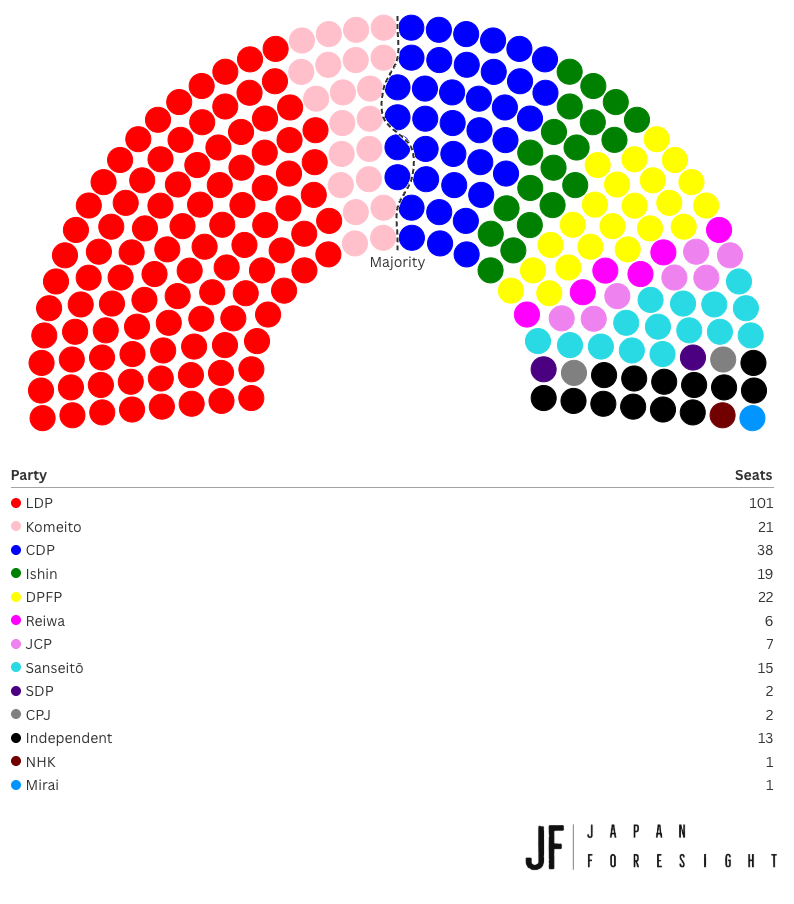
The Japanese political situation is going to be fluid for the foreseeable future, and more details about the election will emerge in the coming days and weeks. In the meantime, here is what we learned on Sunday about some of the most important questions at stake.
The Japanese public showed up at a higher rate than in any election since 2012.
The early indications about turnout were correct. There was a significant increase in turnout compared to both the 2024 general election and the 2022 upper house elections, with one estimate suggesting it was as high as 58.52%. It will take some time to get a clearer picture of the electorate – who voted in greater numbers, where turnout was higher – but the overall picture is that more Japanese are ready to vote again after years of frustration and apathy.
This is, of course, bad news for the LDP.
Despite the greater number of votes, the LDP’s PR vote is, with 98% of the vote counted, just under 10 million votes, which is more than four million PR votes than the LDP received nationally in last year’s general election, which was, in turn, nearly four million votes fewer than the LDP received in the 2022 general election. In short, it is possible that the LDP has lost eight million votes nationally in the three years since the last upper house election. At one point during its election night broadcast, NHK showed support for the various parties in its exit poll this year versus 2022. The LDP’s support was 43% in 2022; it was only 24% this year. Even if the LDP managed to avoid the more pessimistic forecasts from opinion polls during the campaign, its electoral base has dramatically contracted. The party will endlessly debate the reasons – right-wing voters abandoning the party for a putative liberal turn under Ishiba and former prime minister Kishida Fumio for new right-wing parties like Sanseitō, enduring frustration over the party’s corruption scandals, a deep-seated fatigue with the party after its nearly thirteen years of dominance – but it is undeniable that the party faces a major crisis.
And for Ishiba.
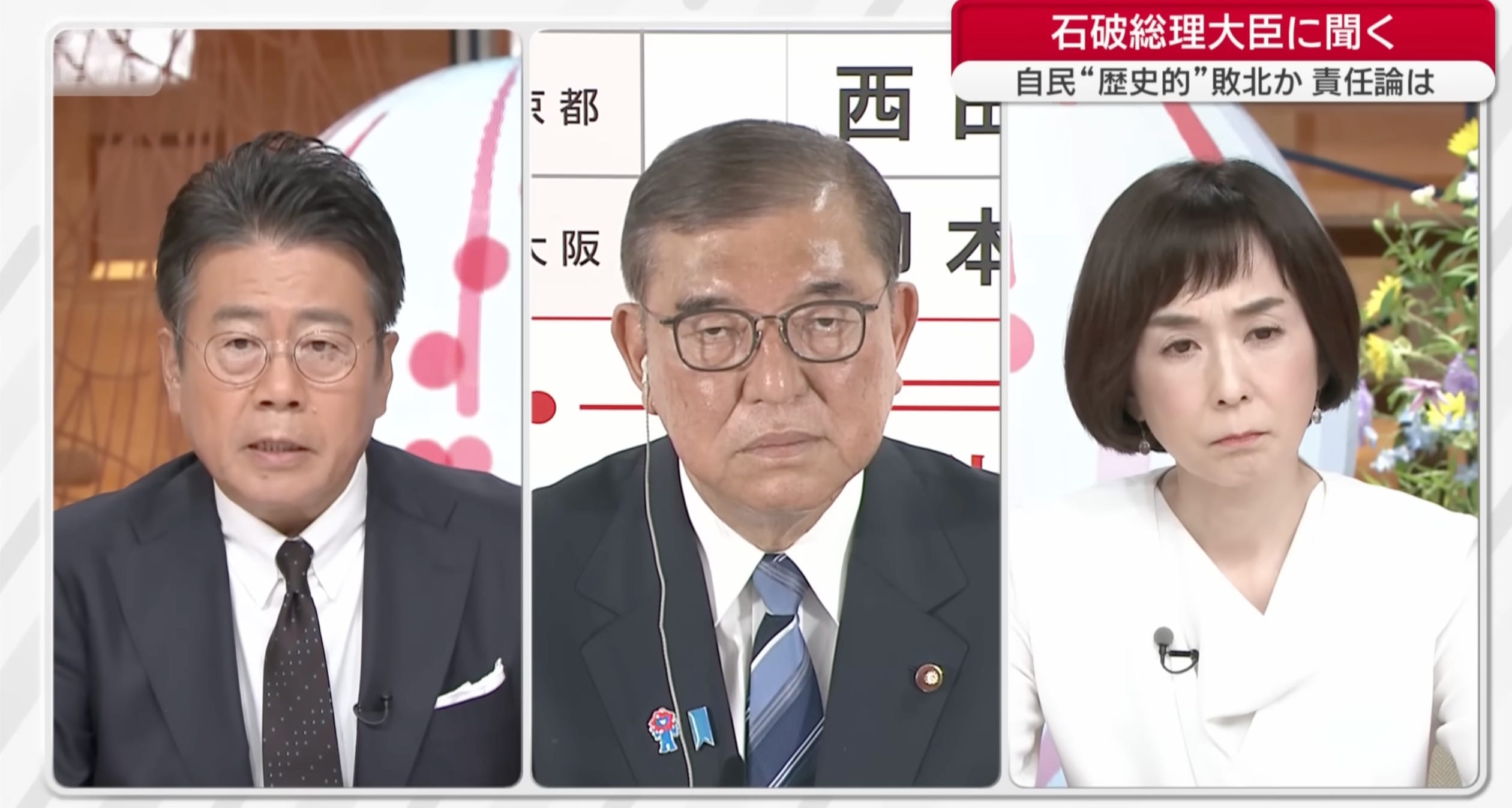
The prime minister says he intends to stay on despite falling short of his self-designated victory line. His party might have different views on the matter. It is difficult to see how an LDP leader who has led the party to two consecutive national election defeats, lost control of both houses, and failed to fend off new challenges on the right will continue to enjoy the confidence of his own party. There are pragmatic reasons for the LDP to support Ishiba’s staying in power – the most commonly cited being of course the ongoing negotiations with the United States – but of course his most committed opponents think that he has mishandled the negotiations and should be removed because of the negotiations. Meanwhile, with the three major opposition parties all indicating that they will not join a coalition government at this time – i.e. as long as Ishiba is its head – Ishiba and the LDP are facing a governing crisis and a political crisis. If Ishiba stays, it seems like it is only a matter of time before he faces an open party rebellion, a no-confidence motion, or perhaps some combination of the two, all of which could lead to a snap election that could endanger the LDP-led coalition’s tenuous hold on power.
But not only the LDP.
The established parties all had at best disappointing nights. Kōmeitō is facing an existential crisis after it lost constituency seats for the first time since 2007 – three of its incumbents lost in “reserved seats” in multi-member districts – and its national PR vote appears to have dropped by roughly a third, falling to a little over 4 million from roughly 6 million in both the 2022 upper house and 2024 lower house elections even as it set a goal of 7 million votes. As the party’s ability to mobilize voters declines, its value as a coalition partner will decline, while it is clear that it has failed to refresh its rank-and-file membership. The LDP still needs its votes in the Diet, but the future not just of the coalition but also of the party itself is in question.
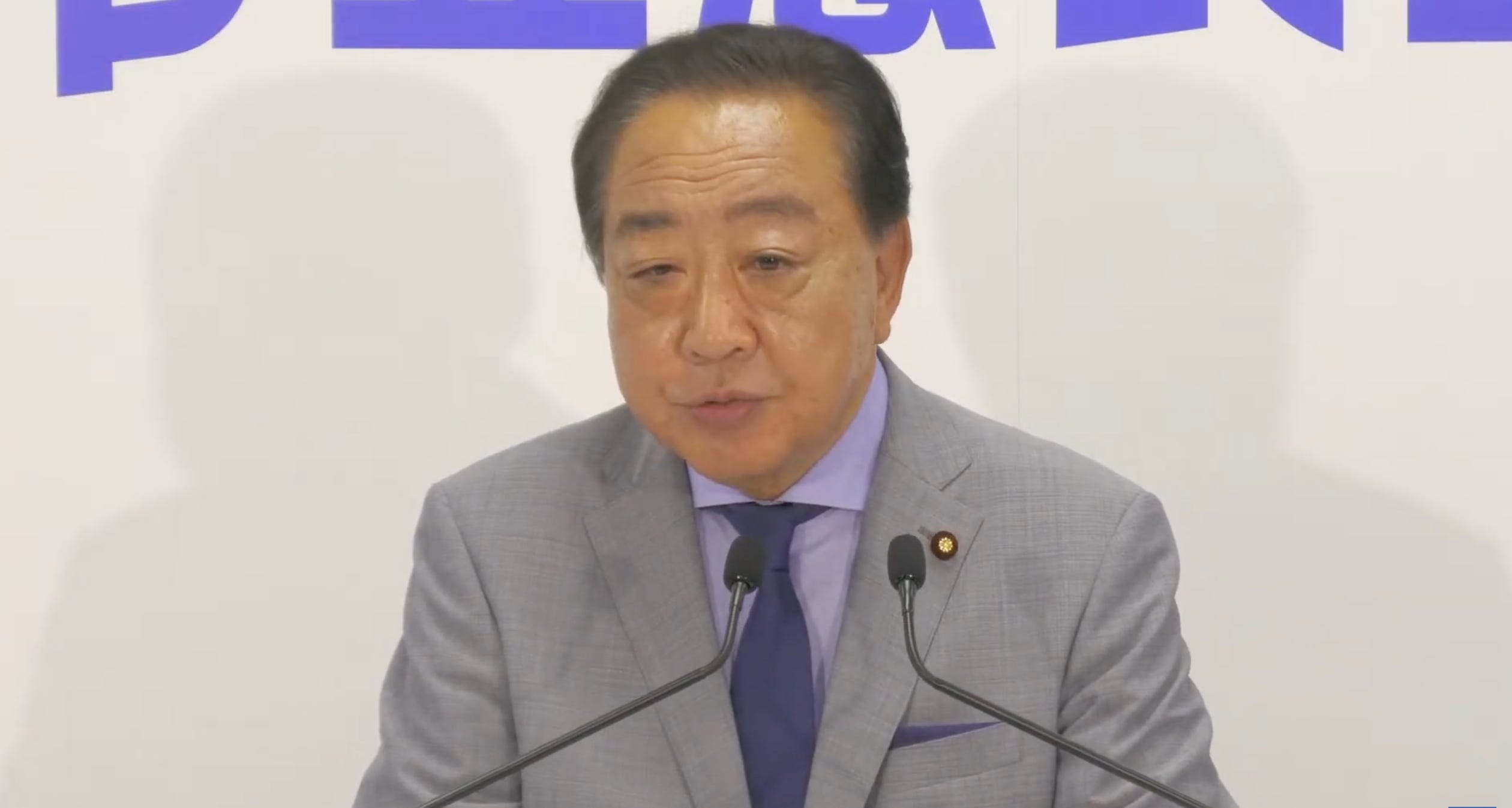
Meanwhile, despite the higher turnout overall, the Constitutional Democratic Party (CDP) failed to net any new seats, entering the campaign with thirty-eight seats and, after winning twenty-two seats, emerging with thirty-eight seats. It also won the exact same number of PR seats – seven – that it won in 2022, which also is the same number of PR seats won by the Democratic Party for the People (DPFP) and Sanseitō. Noda Yoshihiko’s CDP might still be the largest opposition party, but it does not feel large in its impact on the political system. Noda’s own appeals to responsibility were about as well received in the end as Ishiba’s. The party just has not broadened its appeal with independents, particularly younger voters, who have overwhelmingly shunned the party in favor of the new anti-establishment parties. It is unclear whether Noda or any of the party’s DPJ-era leaders can successfully expand the party’s base.
It is perhaps a little strange to think of Ishin no Kai, survivor from an earlier wave of urban populism, but the party increasingly looks entrenched as the establishment party of Kansai, but little else. The party gained a net of one seat, up to seven, but it won only three constituency seats – two in Osaka and one in Kyoto – and will remain preoccupied with defending its position in Kansai in subsequent elections. It has enough heft to be a national player – its thirty-eight lower house seats mean it has significant negotiating power vis-à-vis a minority government – but it feels like another established party trying defend its position from the insurgent newcomers than an energetic, growing party in its own right.
Finally, the Japanese Communist Party (JCP), an established if not an establishment party, has likewise continued to decline, winning only one district seat – in Tokyo – and only two PR seats, while Reiwa Shinsengumi, its rival on the left, won three PR seats. The left on the whole has stagnated even as the right wing has surged. Sanseitō’s seven PR seats were more than the total seats won by the JCP, Reiwa Shinsengumi, and the Social Democratic Party (SDP) combined (though the JCP and the SDP, along with the CDP backed a successful independent in Okinawa aligned with Governor Tamaki Denny).
What about the populist right?
The biggest winner in this election was arguably not Sanseitō – more about them in moment – but the Democratic Party for the People (DPFP), which is now the third-largest party in the House of Councillors after the LDP and CDP, gaining thirteen seats to jump to twenty-two total. The party’s fortunes appeared to be waning just as Sanseitō surged, due to some tactical missteps by party leader Tamaki Yūichirō, but despite competition between the two parties for younger, urban voters, the DPFP appeared to get the better of it. The party won a couple of close races against LDP incumbents in single-member districts, took two of the seven Tokyo seats, and supplanted other parties in several other multi-member districts. Its direct message, Tamaki’s seemingly boundless energy, and his party’s effective use of social media have all made it a critical player in the new political landscape, its twenty-eight and twenty-two seats in the lower house and upper houses respectively giving it substantial leverage vis-à-vis the ruling coalition.
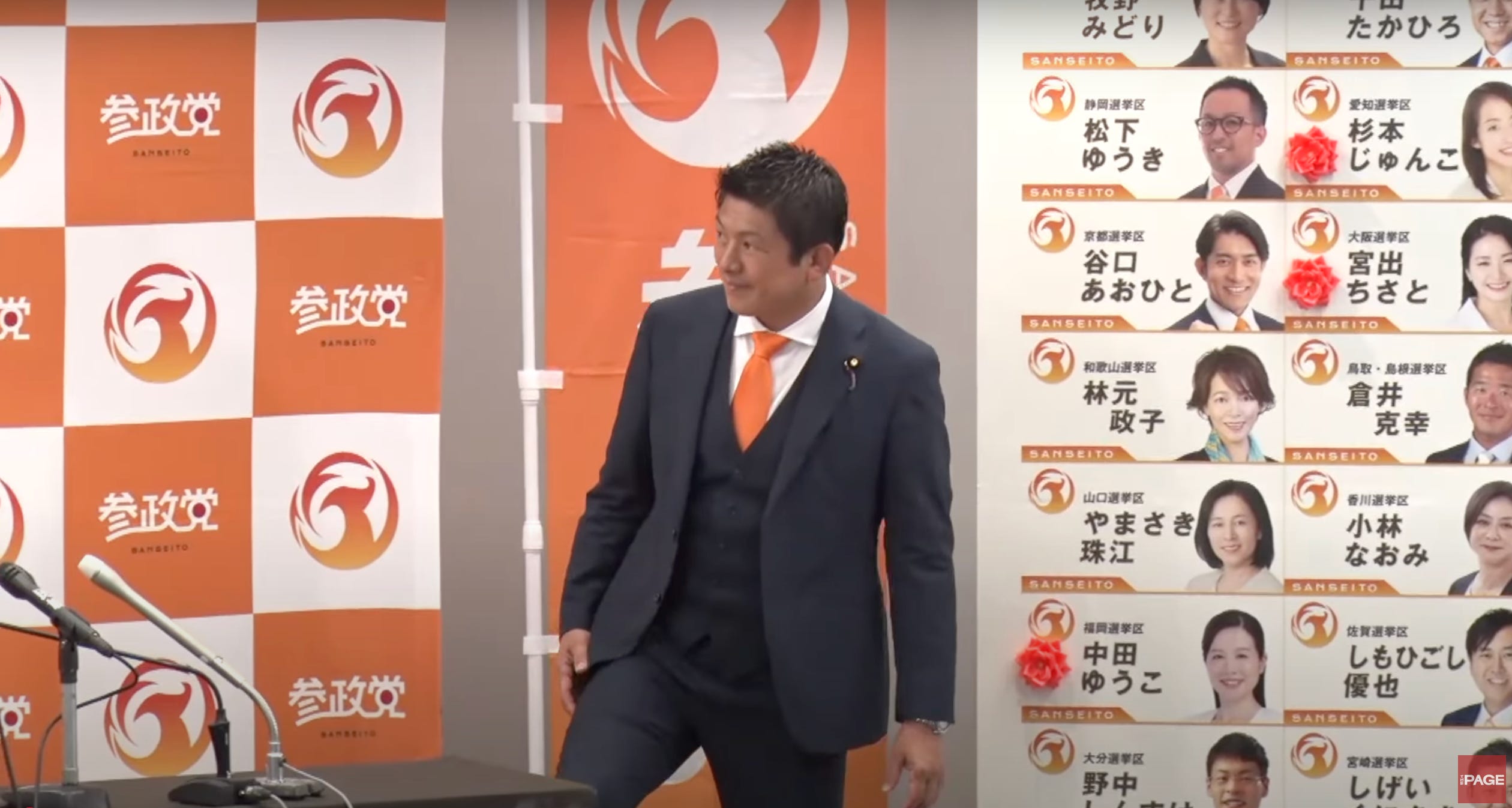
Sanseitō, going from one seat to fourteen, gained the same number of seats in absolute terms, and seemed poised to gain more during the campaign. The party has in the course of a month gone from a fringe presence to a party with real influence in one house of the Diet and whose electoral clout will affect the calculations of every other party, though especially the LDP and its rivals on the populist right. It has harnessed social media and other tools to build a nationwide party that enabled it to field candidates in every single-member constituency, none of whom won but some of whom surely contributed to the LDP’s winning only fourteen of thirty-two. It also showed its ability to influence the public agenda, forcing other parties to address issues around Japan’s foreign population through its relentless focus on “Japanese people first”; it is possible to watch its influence grow in real time as every party rolled out its talking points in response.1 And yet the party’s gains can be overstated, particularly compared to some polls suggesting that it could win close to twenty seats. Importantly, the party has also only begun to be scrutinized by the media and other parties, all of whom were caught off guard by the speed with which Sanseitō advanced. It is at least worth asking whether questions raised about the party’s relationship with Russia days before the election but after the last polls were conducted contributed to its relative under-performance. The party is a factor, but whether it is a more durable challenge to the establishment is by no means settled.
Ultimately both the DPFP and Sanseitō have been able to tap into the anger of younger generations at a political system that has often seemed closed to them, a “silver democracy” and an economy that has seen real incomes stagnant as the cost of living rises. The parties’ successes may reflect their ability to communicate with younger voters through the information channels they use and address their concerns, rather than an indicator that young Japanese are overwhelmingly right wing, not least because their ideological perceptions may differ from common understandings.2
Did the public get what it wanted?
Oddly enough, polls suggested that the public wanted exactly what happened. The ruling parties lost seats but have not lost power and the ruling and opposition parties are almost perfectly matched in the upper house. The problem is that it is difficult to see how this political situation – in which the prime minister and most of the established parties are diminished, while the new parties are growing but are still far from dominant – will yield policies that address the sources of public anger in the first place. It is possible that if Ishiba quits and is replaced by a successor who is able to form a coalition that includes the DPFP or Ishin no Kai, the government might be more stable, but whether and how an expanded coalition would work is anyone’s guess. And the policies that coalition would be likely to pursue could prove counter-productive for the voters that they are intended to help.
—
Ultimately, the upper house elections revealed a political system in deepening crisis, but still a long way from resolving it in a way that makes Japanese democracy more responsive and representative.
Some, like the CDP and JCP, pushed back against Sanseitō and defended a more pluralistic vision of Japanese society.
Both parties can also be chameleonlike too. The DPFP is a party with roots in organized labor that is still close with unions that is led by a former finance ministry bureaucrat and is also conservative on some issues but not uniformly so. Sanseitō, as discussed, mixes more traditional Nippon Kaigi-style conservatism with anti-globalist conspiracism, new age wellness, and some fairly radical small government views.