
"Self-sacrificing reform"
Why Ishin no Kai is demanding that Takaichi spend political capital on reducing the size of the lower house

Thank you for reading Observing Japan. This post is available to all readers.
If you are looking for timely, forward-looking analysis of the stories in Japans’s politics and policymaking that move markets, I have launched a service through my business, Japan Foresight LLC. For more information about Japan Foresight’s services or for information on how to sign up for a trial or schedule a briefing, please visit our website or reach out to me.
From now through 15 December, I am offering a 25% discount on annual subscriptions to Observing Japan. Click below to take advantage of this limited-time offer.
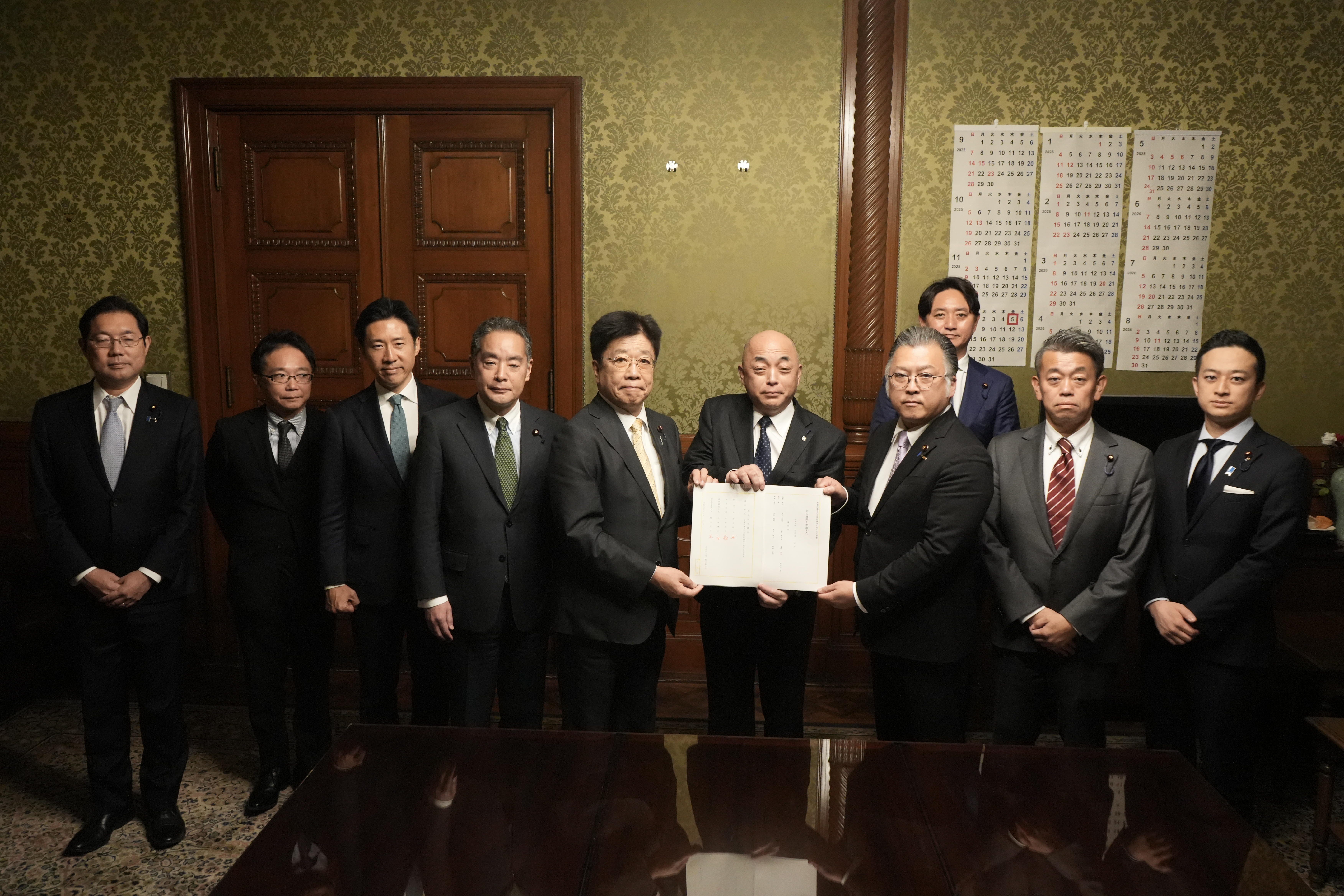
As the extraordinary session of the Diet enters its final week, Prime Minister Takaichi Sanae finds herself in an increasingly difficult situation due to one issue above all others: how to pass a Liberal Democratic Party (LDP)-Ishin no Kai bill that calls for electoral reform and includes a mechanism that would automatically reduce the number of seats in the House of Representatives by forty-five if governing and opposition parties are unable to reach an agreement on electoral reforms within a year of the bill’s passage.
Cutting the number of Diet seats, a longstanding priority of Ishin no Kai’s, was put forward as a compromise in place of the party’s demand for a ban of corporate political donations, a non-starter for the LDP. Ishin demanded that the partnership agreement between the LDP and Ishin include a pledge that the Diet pass this reform by the end of the year; Takaichi accepted, but delivering on that promise has been easier said than done.
First, the LDP forced Ishin to accept that rather than imposing immediate cuts – the party’s demand – it needed to accept an alternative, using the threat of seat cuts to encourage all parties to come to the table to discuss electoral reform.
Now, the legislation has been held up by the opposition parties – thanks in part to the Constitutional Democratic Party’s (CDP) control of the political reform special committee in the lower house – while the parties debate competing proposals for campaign finance reform. The prime minister now has to decide whether to push for the bill’s passage, by, for example, extending the session and/or threatening a snap election, which risks angering LDP backbenchers and Kōmeitō, which has dangled the possibility that it could continue to support some LDP candidates but will not if Takaichi rams the legislation through the Diet. Alternatively, she could try to work out a compromise with the opposition that trades LDP concessions on campaign finance for progress on the electoral reform bill, though neither Takaichi herself nor most of the LDP is not inclined to support the opposition’s proposals to restrict corporate donations. Or she could accept that the bill will not pass this session and try to assuage Ishin no Kai’s fury. Whatever choice she makes could weaken harm her political standing.
But as Takaichi contemplates these options, it is worth asking why this issue is so important to Ishin no Kai.
—
Before exploring Ishin no Kai’s reasoning, however, I want to look at Japan’s House of Representatives in comparative perspective.
As this chart shows, there is nothing particularly egregious about the size of Japan’s House of Representatives compared with other large democracies. (There is also not a particularly robust relationship between population size and legislature size.)
Meanwhile, when looking at the ratio of people per member of the lower house, Japan is relatively under-representative relative to its peers in the G7. Indeed, the United States is the only G7 member with a worse ratio of people to lower house members than Japan.
In short, on the face of it, it is difficult to argue that Japan’s democracy has a problem with over-representation. If anything, the most notable problem in Japan’s democracy is that many voters have felt under-represented by an electoral system that, while less unbalanced than in the past, still gives too much representation to depopulating rural prefectures and not enough to the urbanized prefectures that are still growing or at least are not shrinking. As with any electoral system that uses first-past-the-post voting in single-member constituencies – albeit in Japan’s case offset by some proportional representation seats – it is worth asking whether single-member constituencies are strictly necessary, which many parties have begun asking as they contemplate the reintroduction of multi-member districts or other forms of proportional representation.
But it does not seem that reducing the numbers of lawmakers – effectively increasing the distance of each individual voter from their elected representatives – will improve the quality of Japanese democracy.
If so, why is Ishin no Kai so determined to push this reform in particular?
—
To understand why Ishin no Kai is pushing this proposal, it is worth considering why Ishin no Kai has joined forces with the LDP in the first place. The party, having not only failed in its latest attempt to become a national “third force” but also having experienced declining support in its Kansai stronghold, has turned to cooperation with the Takaichi government in a bid to show that it is still relevant. With Takaichi needing an opposition party’s support to become prime minister, Ishin saw an opportunity to leverage its parliamentary strength for policy concessions, concessions that could enable the party to make the case to voters that it is energetic and effective.
However, as the party’s leaders acknowledged after the pact with the LDP was concluded, this deal was risky for Ishin no Kai; it could be saddled with the LDP’s political baggage with little to show for it. Accordingly, the party insisted that any partnership agreement had to include “self-sacrificing political reforms,” i.e. reforms by politicians that would harm their own interests. This messaging is essential to Ishin no Kai’s identity as a populist-reformist party and pushing this reform at the national level – the party twice overcame local opposition over the past fifteen years to reduce the size of the Osaka prefectural assembly – would be a strong signal that the party remains true to itself. As the party’s website says, “This ‘self-sacrificing reform’ represents one of the core principles underpinning Ishin no Kai: that politicians themselves must lead reforms without clinging to their status or privileges, cutting into vested interests to realize policies.”
In this sense, the fierce opposition this proposal has faced not only from opposition parties but also from LDP backbenchers is proof of concept. The political class is fighting hard for their privileges, which shows why it is necessary for the prime minister to spend her political capital to win this fight. As Professor Kawamura Kazunori of Takushoku University told Mainichi in November, the reform itself is the goal, there is not a higher principle or vision of Japanese democracy that would result from reducing the size of the House of Representatives. Ishin also gestures towards the money that would be saved by having to support fewer representatives, but this argument is secondary to the symbolic value of reform.
The cynical argument, of course, is that Ishin no Kai, by focusing on cutting proportional representation seats instead of constituency seats, is looking to cement its advantages in Kansai given its strength in the region’s constituencies at the expense of its rival Kōmeitō and left-wing parties hated by Ishin no Kai. This argument carries less water now that the LDP forced Ishin to accept that the seat cuts, if implemented, would be a mix of single-member constituencies and proportional representation seats.
—
It is immediately apparent why this is a problem. For the opposition parties, of course, they have logic and self-interest on their side. They can argue that Ishin’s gesture – imposed on other parties – could make Japanese democracy qualitatively worse by increasing the distance between the people and their representatives. For Takaichi and the LDP, meanwhile, they are being asked to spend political capital and run the risk of a backlash for the sake of a reform that imposes real costs – some estimates suggest that urban prefectures would lose more representation than rural prefectures – while mostly aimed at shoring up Ishin no Kai’s populist bona fides. Hence the difficult decision that Takaichi faces. No wonder there is a certain lack of enthusiasm on the part of the LDP to run those risks.
If there is a silver lining, it could be that it is spurring more discussion of Japan’s electoral system and whether it is in need of reform. But, as opposition parties (and former prime minister Ishiba Shigeru) have complained, the mechanism itself is heavy-handed and anti-democratic. And ultimately, that may be enough to lead the prime minister to call Ishin no Kai’s bluff and shelve the issue for the time being.