

Thank you for reading Observing Japan. This post is available to paid subscribers.
If you are looking for timely, forward-looking analysis of the stories in Japans’s politics and policymaking that move markets, I have launched a service through my business, Japan Foresight LLC. For more information about Japan Foresight’s services or for information on how to sign up for a trial or schedule a briefing, please visit our website or reach out to me.
All readers can access regularly updated charts of a ten-day moving average of the government’s popularity here.
Another round of polling shows that while Prime Minister Takaichi Sanae’s support has not increased significantly, the public is broadly satisfied with her government and the outcome of the general election. That said, this round of polling did show some potential unease over the direction of fiscal policy under the Takaichi government.
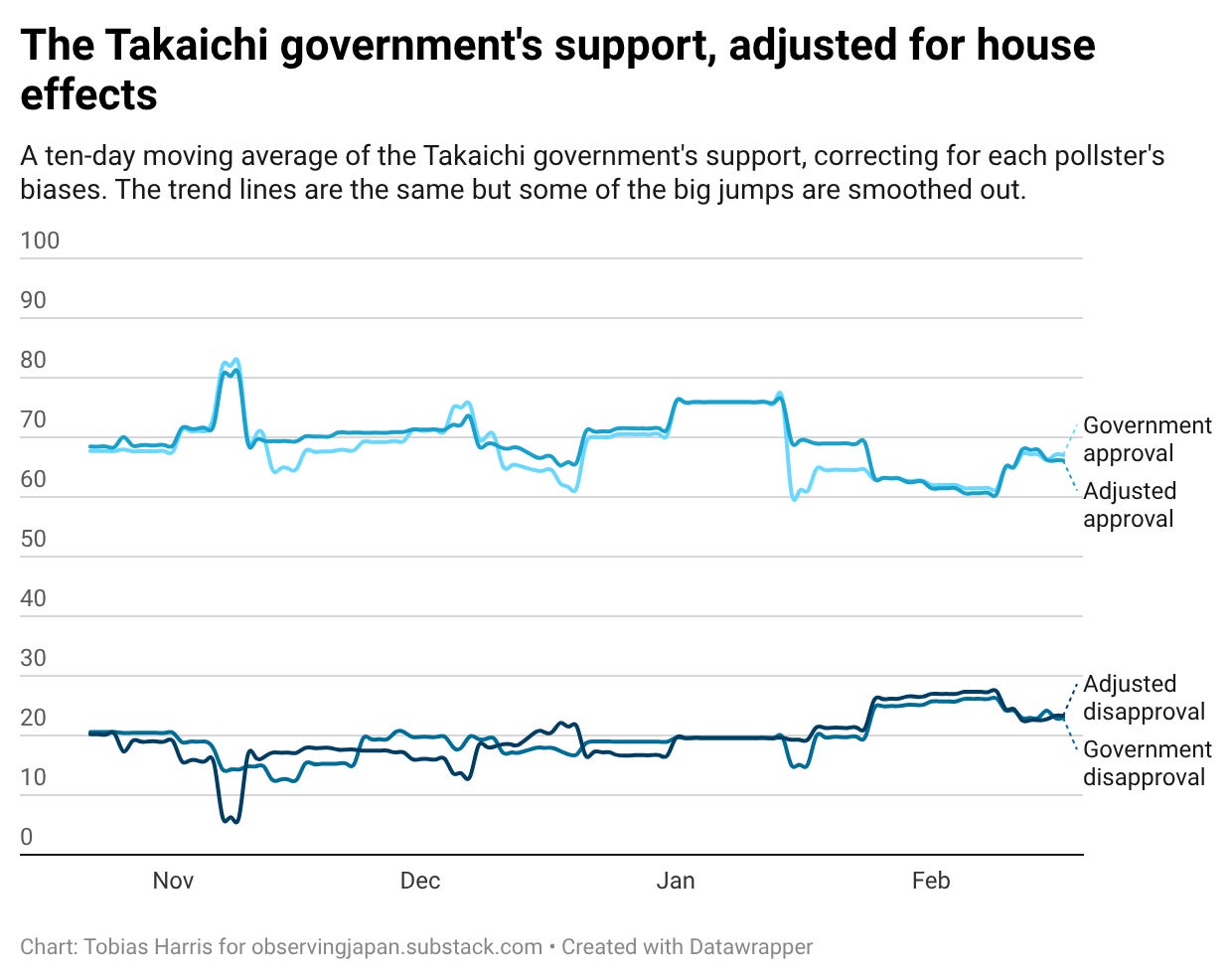
Four new polls conducted over the weekend – from the Nikkei Shimbun, Asahi Shimbun, Sankei Shimbun-Fuji TV, and NHK – show that while some individual polls recorded increases, the average level of support for the Takaichi government remains largely unchanged. For example, although NHK recorded a seven-point gain in approval, reversing the pre-election decline in support, this gain was offset by a four-point drop in Asahi. The ten-day weighted average approval was 67%, while disapproval was 23%, both virtually unchanged from last week. These numbers barely move – to 66.13% and 23.3% respectively – when correcting for pollster biases.
NHK provided some useful insight into the shape of both the Takaichi government’s support and the Liberal Democratic Party’s (LDP) electoral support. Regarding the former, the government’s support remains relatively higher among the young: above-average approval for voters below 60 (74% among under-40s, 81% among 40-49, 75% among 50-59) and at or below average among voters over 60 (65%, among 60-69, 54% among 70-79, 62% among 80+). Her support is also higher among men (68%) than woman (61%). Separately, NHK asked respondents who voted for either the LDP or the Centrist Reform Alliance (CRA) in proportional representation to explain what determined their vote. Among LDP voters, 31% said it was due to their impressions of the party leader, followed by 26% who cited policy proposals. Among CRA voters, 36% cited their impressions of the party, while 31% cited policy proposals. Only 3% said they voted for the CRA due to their impressions of party leadership. In both sets, 17% said they cast their votes due to their impressions of party candidates.
